 Image Source
Pamukkale, is a natural site in
Denizli Province in south-western Turkey. The city contains hot springs and travertines, terraces of carbonate minerals left by the flowing water. It is located in Turkey's Inner Aegean region, in the River Menderes valley, which has a temperate climate for most of the year.
It is one of Turkey’s incomparable natural wonders with the calcium cascade terraces of snow-white stalactites, and is known as 8th wonder of the World by Turkish people. Pamukkale & Hierapolis together are both recognized as
UNESCO World Heritage Sites since 1988. They have all the conditions required for an ideal touristic resort. Pamukkale means “Cotton Castle” but had many different uncommon names in the past, and is not only very well known with the entrancing beauty of its unique geological formation, but also with its historical remains.
 Image Source
Tourism is and has been a major industry. People have bathed in its pools for thousands of years. As recently as the mid 20th century, hotels were built over the ruins of Heropolis, causing considerable damage. An approach road was built from the valley over the terraces, and motor bikes were allowed to go up and down the slopes. When the area was declared a world heritage site, the hotels were demolished and the road removed and replaced with artificial pools. Wearing shoes in the water is prohibited to protect the deposits.
Geologically, the terraces of Pamukkale are made of
travertine, a sedimentary rock deposited by water from the hot springs. The water that emerges from the 17 hot water springs in the area is transported over 1000 feet to the head of the travertine terraces, where calcium carbonate deposits onto a 200-230 feet-long section - covering an expansive area of 790 feet to 980 feet. When the water reaches the surface, carbon dioxide degases from it, and calcium carbonate is deposited. This continues until the carbon dioxide in the water balances the carbon dioxide in the air. Calcium carbonate is deposited as a soft jelly-like substance, but this eventually hardens into travertine.
The entire process is (of course) affected by weather conditions, ambient temperature, and the flow duration, as well as many other factors of rarer occurrence. The result is a beautiful, ever-changing serenity of warm pools surrounded by solid white, cotton-like castle formations.
Sources: 1, 2, and 3.Here are a few more images:
 Image Source Image Source
 Image SourceHere is an awesome Powerpoint presentation: (Please click on menu at the bottom left to view full-screen!)


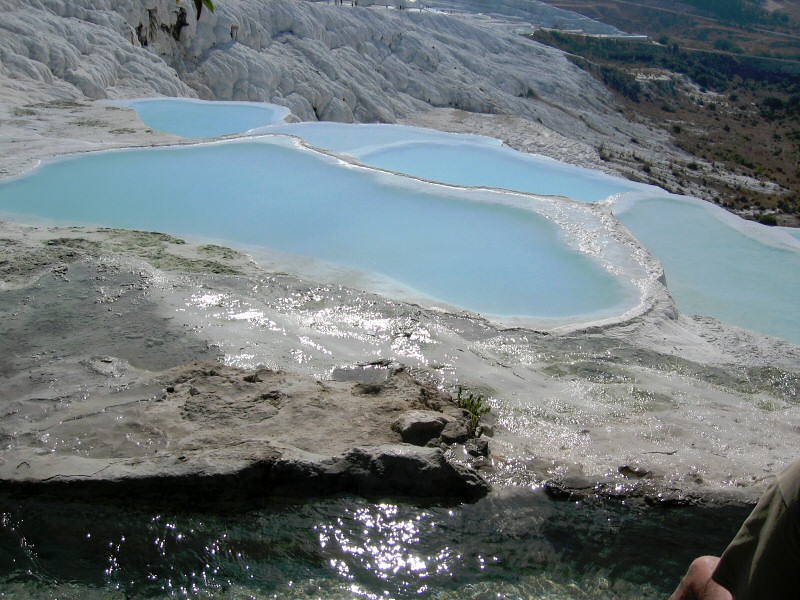 Image Source
 Posts
Posts


